Campus Fund

Portfolio · Investment Note

Banza

The user-controlled data layer the agentic internet was missing turning fragmented private behavior into cryptographically verified signal that AI agents and enterprises can actually trust.

Personal AI · Data Infra

Pre - Seed

HQ

Bengaluru

January 2026

01 — The Opportunity

Agentic AI is moving from suggestion to execution. McKinsey reports 38% of enterprises are already scaling agent systems and 62% are experimenting — but autonomous agents cannot operate on scraped or inferred context. They need verifiable personal data to act on a user’s behalf.

Meanwhile, large platforms are restricting APIs faster than ever, driven by AI training risk, regulatory liability, and monetization pressure. The data agents most need is precisely the data becoming hardest to reach. The downstream pain cascades: personalization stalls on cold-start problems, market research leans on panels and surveys that miss real behavior, and customer acquisition spend pours into probabilistic ad platforms because nobody can target on verified intent.

Whoever builds the trusted data layer in the middle of all this becomes infrastructure.

0 %
Of internet data sits behind APIs, walled gardens, and regulations
0 B
Projected agentic AI market by 2032 — up from $6B today (~43% CAGR)
0 T
Forecast global AI market by 2033 — ~30% CAGR from $390B today
0 %
Of enterprises already scaling agent systems (McKinsey)

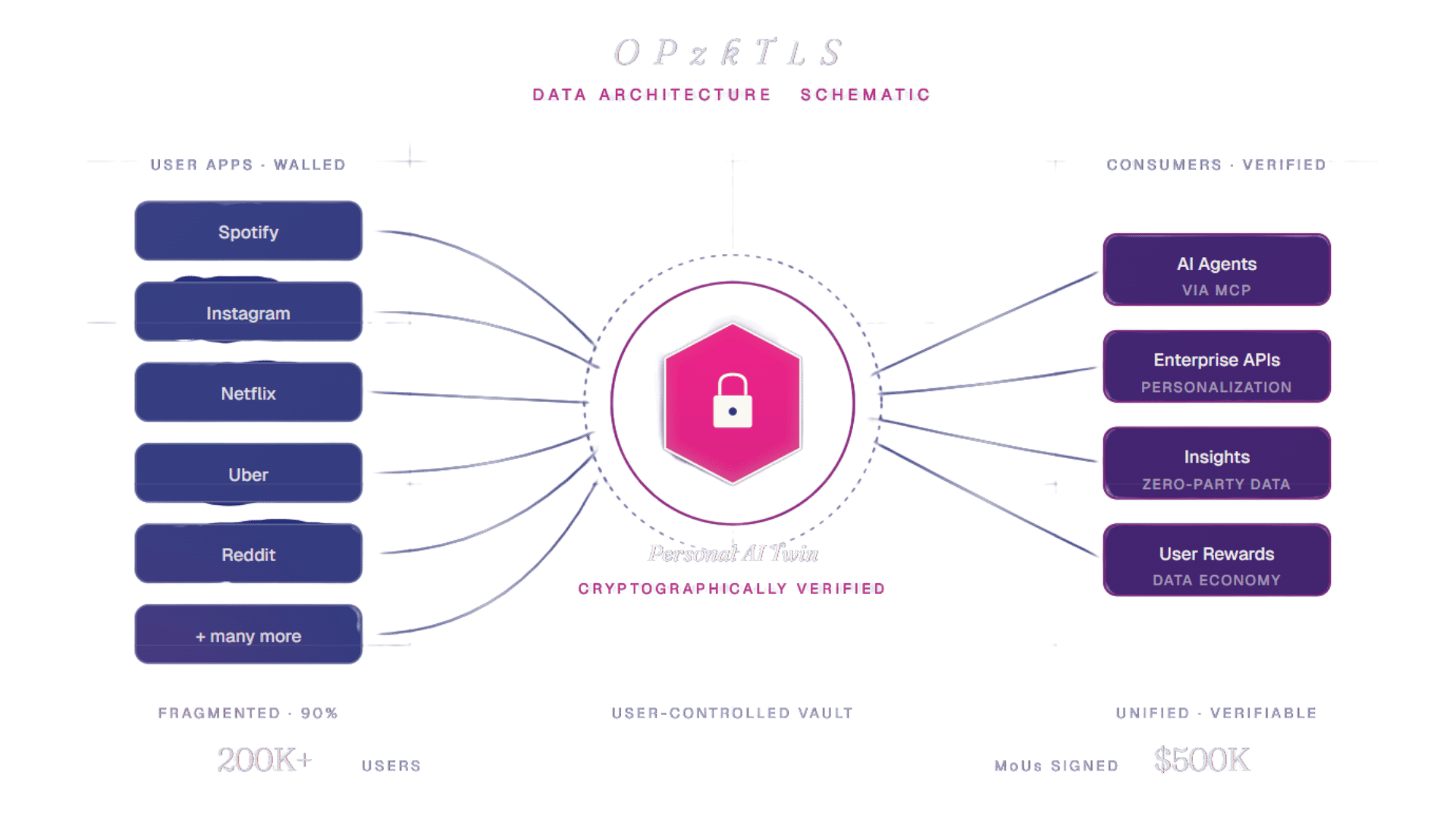
OPzkTLS. Banza’s proprietary zero-knowledge TLS implementation lets users generate cryptographic commitments to real session data on their own devices, without third-party attestors, proxies, or notaries.

02 — The Solution

Banza is building the private, user-controlled data consumption layer this new internet needs, an intelligence substrate between users and the AI agents and enterprises hungry for real behavioral context. Users opt in and self-attest their private digital interactions across the apps they already use; Banza transforms those interactions into standardized, anonymized signals delivered through APIs and Model Context Protocol connectors.

The sharpest claim is simple. Every Banza signal is cryptographically verified, not probabilistically inferred. Traditional data brokers, panels, and survey platforms produce educated guesses. Banza produces proofs. For an enterprise running personalization or an AI agent acting on a user’s behalf, that distinction collapses the difference between hoping a signal is true and knowing it is.

The foundation is OPzkTLS, Banza’s proprietary zero-knowledge TLS implementation. Existing zkTLS systems depend on third-party attestors, proxies, and notaries that introduce censorship risk, latency, and cost. OPzkTLS removes them entirely. As users keep attesting, their Personal AI Twin compounds in fidelity, a longitudinal moat that capital alone cannot replicate.

By seamlessly integrating third-party marketplace data with brand insights, Dcluttr delivers what other platforms cannot: real-time, proactive intelligence. When a campaign's ROAS dips or inventory drops across specific pin codes, brands get immediate alerts with actionable solutions, not reactive reports that arrive too late.

The platform's AI doesn't just aggregate; it performs automated root cause analysis, compares product performance across cities, tracks competitor pricing in real-time, and surfaces the granular insights that turn quick commerce complexity into competitive advantage.


04 — The Verdict

Campus Fund takes pride in backing bold student entrepreneurs who tackle complex, industry-defining challenges. Banza is exactly that kind of bet — foundational infrastructure at the intersection of decentralized identity, AI, and the consent economy, anchored by a student CTO who built the cryptographic primitive at its core.

The market timing is structural, not cyclical. API retrenchment, regulatory liability, and AI’s hunger for real behavioral context are rational long-term incentives that will only intensify. Every API shutdown strengthens Banza’s relative positioning.

Early traction validates the thesis. Banza has crossed 200,000+ users with low CAC and strong engagement, signed approximately $500K in MoUs, and was named a Top 5 finalist in the AWS & Campus Fund Startup Grand Challenge. That is real demand-side appetite from a product barely out of public beta. The closed loop works: users generate verifiable private data, Banza validates and transforms it, and early consumers pull that intelligence into their workflows.